



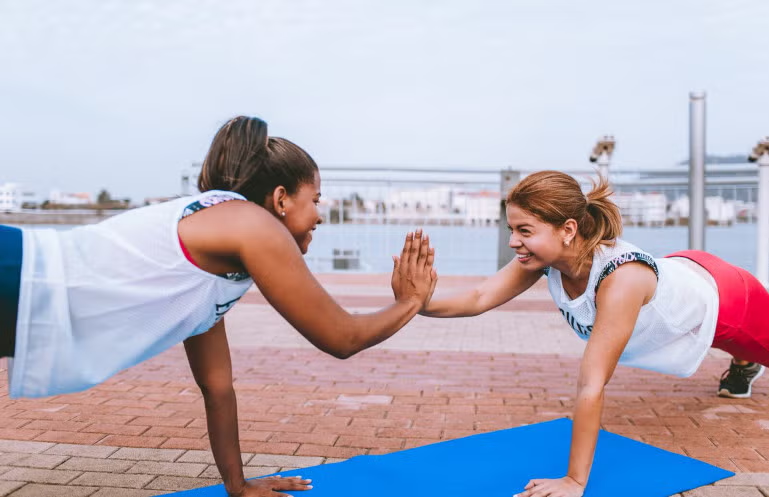
Ab workouts are an excellent way to strengthen your abdominal muscles and support your efforts in attaining a lean physique. For strong abs and a supportive core, incorporate core training exercises.
Related Reading: ONE WEEK WORKOUT PLAN TO JUMPSTART WEIGHT LOSS
The core encompasses the muscle around your hips, spine, back and pelvis. Core training exercises provide the stamina to perform tougher workouts without straining other body parts. Practical core exercises can help to support spine and back health. If you’re just starting out, here are some of the best core exercises for beginners:
PLANK
The plank is an easy exercise that provides your core with numerous benefits, making it one of the best core strengthening exercises for beginners. The plank helps build core strength and stability, allowing you to engage in other physical workouts. It also helps to strengthen and support your back muscles while performing strenuous activities.
To perform the plank exercise, lay face down on your yoga mat. Lift yourself off the ground and support yourself using your forearms and toes. Your elbows should be straight under your shoulders and spine in a level, neutral position. Now, maintain this position for 10 to 20 seconds and engage your abdominal muscles by pulling your elbows towards your toes and draw your navel towards your spine. Modify by keeping your knees on the ground and advance when ready.
Ensure you don’t arch your back, sag your hips, or tilt your head too far upwards for best results. Don’t forget to stay relaxed throughout the process! As you become more comfortable, increase your time in the plank position and try more complex plank exercises such as:
- Plank arm lifts: The plank arm lift requires you to maintain the same floor plank position and stretch each arm forward at different intervals in the air.
- Side plank: The side plank requires you to lift yourself on one side using your elbow. It is more complicated than the rest, so it requires building more core strength first.
- Incline ball plank: This is similar to the floor plank, only that you’re now placing your forearms on a stability ball. The instability allows you to build more core strength.
- Plank leg lifts: Plank leg lifts require you to maintain your initial floor plank position and stretch your left and right foot behind at different intervals.
GLUTE BRIDGE
Just as its name suggests, the glute bridge exercise targets the glute muscles in your core. The glute muscles are the three muscles that make up the buttocks. They can often underperform after long hours sitting on the couch, at a desk, or behind the wheel.
The glute bridge exercise helps activate the glute muscles and stabilize and strengthen your core. To perform the glute bridge core exercise, start by lying down on your back with your knees bent and feet planted on the ground. Your toes should point straight forward, and your arms should be by your side with the palms facing down.
Using your glute and hamstring muscle, try to lift yourself from that position by sending your hips as high as possible towards the ceiling until your knees, and hips align. Squeeze your glutes while in this position and head back down to the floor, maintaining the same pressure.
Repeat this movement a few times and ensuring your legs are hip distance apart to avoid overworking your hamstring more than your glutes. You can also add wearable weights or place a dumbbell on your hips while doing your glute bridge to make it more complex and engaging.
BIRD DOG
The bird dog is the most straightforward exercise of all beginner core exercises. It resembles a hunting dogs’ pointing position, hence the name “bird dog.” But more than that, this exercise utilizes your entire body to strengthen your core, especially the hips and back muscles. In return, it helps to stabilize your back, increase your range of motion, and supports improvements in posture.
That said, performing the bird dog exercise requires you to go down on all four limbs with your palms and knees planted on the ground. Ensure your back is in a flat, level position and your shoulder blades are closer together. Then, stretch your right arm in front of you and the opposite corresponding limb (your left leg) behind you. Maintain that position for a few seconds and switch to the other limbs. Alternate limbs as you continue.
You can stretch yourself further by bending your stretched arms and legs toward your stomach. Just avoid shrugging your shoulders too much or lifting your leg too much either. You should also keep your hips level and the back of your neck in line with your spine to prevent arching. Always
focus on moving your entire body when doing bird dog rather than isolated muscle movements for the best results.
DEAD BUG
Few core strengthening exercises compare to the dead bug in terms of its benefits to your body. In its entirety, this exercise can be summarized as the total package of core exercises. including the anterior and posterior core, hips, and obliques.
What’s more, the exercise is simple to perform. Start by lying on your back with your feet off the ground and knees bent at 90 degrees. Your arms should stretch above your shoulder such that you resemble a ‘dead bug.”
Ensure your back is flat on the ground by pushing your abdominal muscles against it. While in this position, extend your right arm behind you and your left leg in front of you. Return them to their original position and switch to the other limbs. Keep your knees bent if straightening your legs is too difficult. You can also incorporate different variations of the dead bug as you get used to it. These include:
- Weighted dead bug
- Dead bug rollover
- Stability ball dead bug
Over time, this exercise can help to support your posture and coordination.
SUPPLEMENT YOUR CORE STRENGTHENING EXERCISES WITH EXCELLENT EQUIPMENT
As you become comfortable with these core exercises you can incorporate more complex core training. Remember, your core is essential for other exercises you plan on doing, whether running or pure gym work. Be sure to choose fitness equipment to best serve your goals.
