



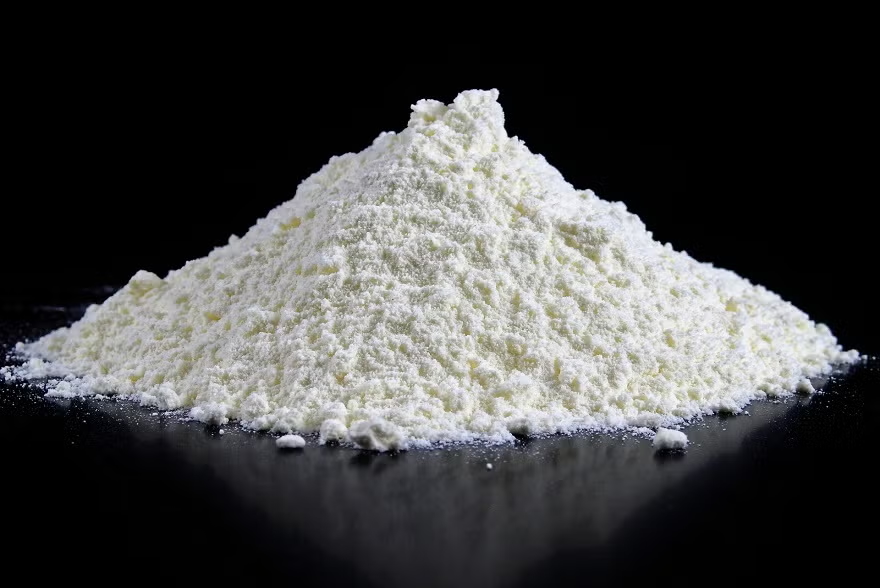
Creatine. The GOAT of sports nutrition supplements – studied, proven, and effective. Creatine has been around the block a few times since it was first discovered, way back in the mid-1800’s! And while supplementation wasn’t mainstream until the early 1990’s (thanks to the Barcelona Olympic Games), today it is undoubtably one of the most popular ergogenic aids for sports performance [1].
Given it’s nearly 225 years of (known) existence, creatine, and creatine research has come a long way. Most notably, the evolution of different types of creatine. According to a 2022 publication, following a search for the word “creatine”, over 88 creatine-related compounds were listed in the PubChem database [2]. And while not all 88 creatine-related compounds are commercially available, it just goes to show – the research is evolving, and scientists continue to hunt for the next big thing.
So, what are the different types of creatine? Which is best? And does it really matter? Read on to learn more about common forms of creatine and what to look out for on the label.
CREATINE MONOHYDRATE
Creatine monohydrate is the most researched and well-known form of creatine, consisting of a creatine molecule and water molecule to provide ~90% creatine by weight [3]. Because of its popularity, creatine monohydrate is the easiest to find and purchase as a single ingredient, and often the most cost effective. It will be listed on an ingredient label as “creatine monohydrate”.
One drawback is that creatine monohydrate powder has low solubility in water – which means it “doesn’t mix well”. This requires creatine powders to be consumed with large doses of water. And, when following a loading phase, can leave you feeling bloated. Good news! This is totally normal and will subside after when you start your maintenance dose. Curious about creatine dosing? Check out our Ultimate Guide to Creatine Dosing article.
CREATINE ANHYDROUS
Through a drying process, the water molecule that is part of creatine monohydrate is removed. This creates creatine anhydrous. Removing the water molecule increases the amount of creatine by weight to 100% [4]. Creatine anhydrous will be listed on an ingredient label as “creatine anhydrous”. It is more common to find creatine anhydrous in capsules.
MICRONIZED CREATINE
When creatine molecules undergo mechanical processing, micronized creatine is formed. Increasing the surface area of creatine molecules may improve water solubility and absorption [5-7]. You’ll see “micronized creatine” (as creatine monohydrate) in powder form and some pre-workouts.
READ MORE: The Power of Creatine – Pre Workout Ingredient Breakdown
Creatine Hydrochloride
Creatine hydrocholoride, or creatine HCl, is another popular form of creatine, bound to hydrochloric acid. Creatine HCl is thought to have greater absorption and bioavailability when compared to other forms of creatine, boasting superior solubility in water, requiring a lower dose for similar effects [6]. You can find creatine HCl in both pill and powder form and as part of pre-workouts formulas.
Creatine Citrate
– Creatine citrate is a creatine molecule bound to citric acid.
Creatine Pyruvate
– Pyruvic acid is bound to creatine.
Creatine Hydrochloride
– Creatine hydrocholoride, or HCl, is another popular form of creatine, bound to hydrochloric acid. HCl is thought to have greater absorption and bioavailability when compared to other forms of creatine, boasting superior solubility in water, and requiring a lower dose for similar effects [7]. You can find Creatine HCl in both pill and powder form, and as part of pre-workout formulas.
GNC AMP Creatine HCl 189™
GNC conducted two performance studies, testing an innovative creatine technology, pairing creatine HCl with polyethylene glycosylate (PEG) to create the PEG-Creatine System™. With the addition of polyethylene glycosylate, muscle creatine uptake increased by 189% when compared to creatine monohydrate with the same exercise benefits, you’d expect – at a lower dose [8,9]! GNC AMP Creating HCl 189™ is only found in pills.
OTHER FORMS OF CREATINE
You may see a few other forms of creatine listed on labels. The following forms of creatine are newer to the “scene” and require additional research to determine their effectiveness compared to the gold standard, creatine monohydrate.
- Creatine Nitrate
- Buffered Creatine
- Creatine Ethyl Ester
- Magnesium Chelated Creatine
And while I could go on and on and on…. to include MANY more forms of creatine and creatine powders – I’m going to stop here!
So which creatine form is best? Does one perform better than the other? Because there has been SO MUCH work done on creatine monohydrate, it’s tough for other forms to “compete”. As of now, alternative forms perform just a well.
Finding creatine supplements is the easy part, choosing the best one is up to you! No doubt you’ll experience all the benefits this performance boosting ingredient has to offer! Thankfully, GNC has got you covered to achieve your fitness goals and help you Live Well.
- Butts J, Jacobs B, Silvis M. Creatine Use in Sports. Sports Health. 2018 Jan/Feb;10(1):31-34. doi: 10.1177/1941738117737248. Epub 2017 Oct 23. PMID: 29059531; PMCID: PMC5753968.
- Kreider RB, Jäger R, Purpura M. Bioavailability, Efficacy, Safety, and Regulatory Status of Creatine and Related Compounds: A Critical Review. Nutrients. 2022; 14(5):1035. https://doi.org/10.3390/nu14051035
- Jäger R, Purpura M, Shao A, Inoue T, Kreider RB. Analysis of the efficacy, safety, and regulatory status of novel forms of creatine. Amino Acids. 2011;40(5):1369-1383. doi:10.1007/s00726-011-0874-6.
- Antonio J, Candow DG, Forbes SC, Gualano B, Jagim AR, Kreider RB, Rawson ES, Smith-Ryan AE, VanDusseldorp TA, Willoughby DS, Ziegenfuss TN. Common questions and misconceptions about creatine supplementation: what does the scientific evidence really show? J Int Soc Sports Nutr. 2021 Feb 8;18(1):13. doi: 10.1186/s12970-021-00412-w. PMID: 33557850; PMCID: PMC7871530.
- Ali Zeinolabedini Hezave, Sarah Aftab, Feridun Esmaeilzadeh. Micronization of creatine monohydrate via Rapid Expansion of Supercritical Solution (RESS). The Journal of Supercritical Fluids, Volume 55, Issue 1, 2010, Pages 316-324. ISSN 0896-8446 https://doi.org/10.1016/j.supflu.2010.05.009.
- Miller, D. W., Augustine, S., Robinson, D. H., Vennerstrom, J. L., & Wagner, J. C. (2013). Oral Bioavailability of Creatine Supplements. Nutrition and Enhanced Sports Performance, 395–403. doi:10.1016/b978-0-12-396454-0.00040-0
- Kreider RB, Jäger R, Purpura M. Bioavailability, Efficacy, Safety, and Regulatory Status of Creatine and Related Compounds: A Critical Review. Nutrients. 2022; 14(5):1035. https://doi.org/10.3390/nu14051035
- Fry, Andrew C.1; Parra, Mandy E.2; Cabarkapa, Dimitrije1. Supplemental Creatine Modified With Polyethylene Glycol Effectively Loads Skeletal Muscle With Lower Doses. Journal of Strength and Conditioning Research 35(5):p 1256-1261, May 2021. | DOI: 10.1519/JSC.0000000000003906
- Herda TJ, Beck TW, Ryan ED, Smith AE, Walter AA, Hartman MJ, Stout JR, Cramer JT. Effects of creatine monohydrate and polyethylene glycosylated creatine supplementation on muscular strength, endurance, and power output. J Strength Cond Res. 2009 May;23(3):818-26. doi: 10.1519/JSC.0b013e3181a2ed11. PMID: 19387397.
